In today’s world, naps are no longer a luxury. They’re a form of survival.
A short pause in the middle of the day (even just 20 minutes of mental rest) can radically change how we feel, from reducing stress, restoring emotional balance, improving focus, and supporting mental health.
I’m sure you know exactly what I’m talking about: that rare nap that resets the entire afternoon, sometimes even the day.
When we rest well, we think more clearly. We feel more grounded. We’re kinder too, to ourselves and to others.
And yet, despite how powerful naps can be, they’re often the first thing we sacrifice.
The paradox of modern naps
We live in a world where mental rest is deeply needed… and yet we don’t make space for it. Our attention is constantly pulled outward with endless notifications and the pressure to respond, keep up, stay available.
Add to that a culture that glorifies busyness and productivity, and rest can start to feel like something we have to justify, or squeeze in only once everything else is done (sounds familiar?) 🙋♀️
Most of us don’t have the luxury of long breaks during the day. Napping at work often feels unrealistic (not because we don’t need it, but because there isn’t a space for it, or because it feels socially uncomfortable). I often hear people tell me they nap in their car, just so no one sees them… and it’s just sad.
If employers truly understood how much more productive, focused, emotionally balanced, and creative people become after short periods of real mental rest, naps might look very different in our culture.
So the question is:
How do we make a short nap (20 minutes or less) as restorative as possible?
When time is limited, depth matters more than duration.
Why deep sleep matters more than how long you nap
Sleep is not a single state. It’s made of different stages, each with a distinct physiological role.
• Light sleep supports transition and relaxation
• REM sleep is linked to memory and emotional processing
• Deep sleep is where the body and nervous system recover most intensively
During deep sleep:
• parasympathetic (rest-and-digest) activity dominates
• stress hormones decrease
• physical repair and immune processes increase
• the brain restores internal balance ( = better regulation of attention, emotions, stress response, and cognitive flexibility)
Studies consistently associate deep sleep with improved mood stability, reduced inflammation, better hormonal regulation, and clearer thinking the next day.
If a nap contains little or no deep sleep, it may feel pleasant, but it won’t deliver the same level of recovery (and we want recovery!)
The real challenge: crossing the physiological threshold
One of the most surprising findings from our internal experiment was this:
In several sessions, the subject (me, Julie 🙋♀️) felt asleep yet the wearable classified the session only as “rest,” not sleep.
This distinction matters.
Wearables like the
Oura Ring:
Detect sleep using physiological signals such as heart rate, heart rate variability, movement, and temperature trends. Feeling asleep does not always mean the nervous system has crossed into sustained sleep physiology.
In other words: the body can relax without fully entering deep recovery.
The experiment: how we compared different nap setups
Over several weeks, we analyzed short afternoon naps using an Oura Ring under four different conditions:
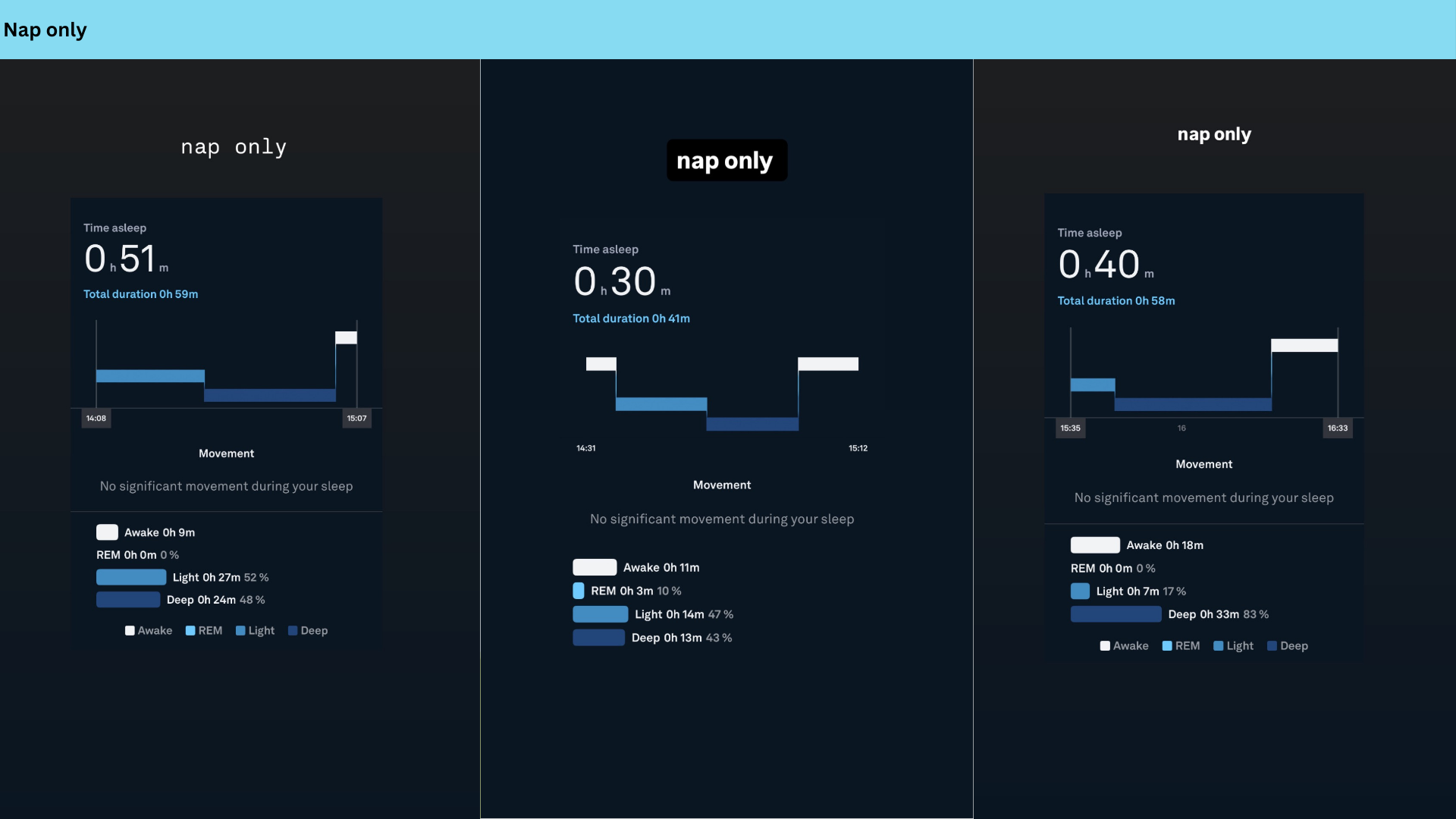
- Nap only (no tools) (5 naps detected as sleep)
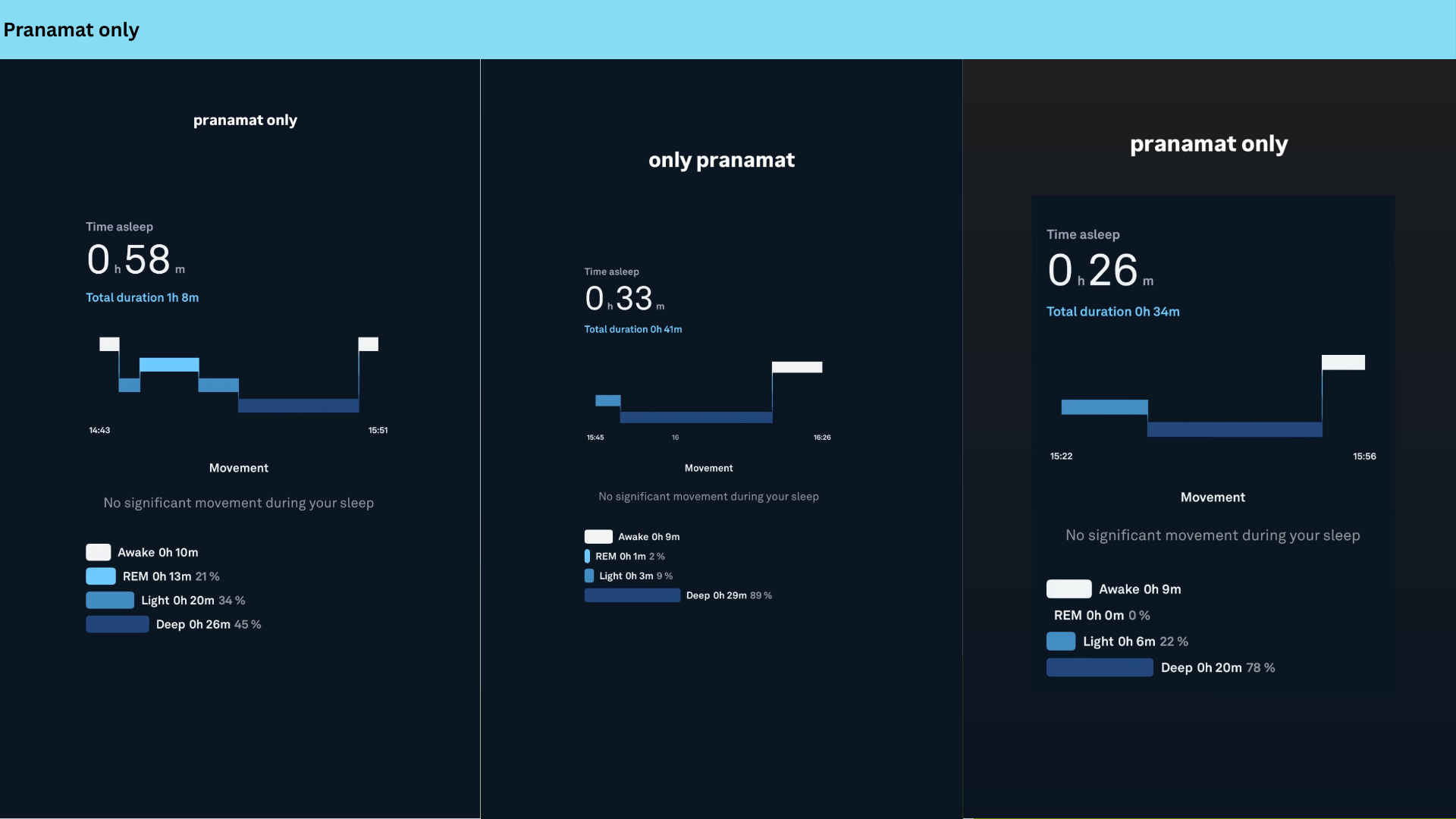
- Nap with Pranamat only (3 naps detected as sleep)
(lying on an acupressure mat designed to stimulate the body through gentle pressure points)
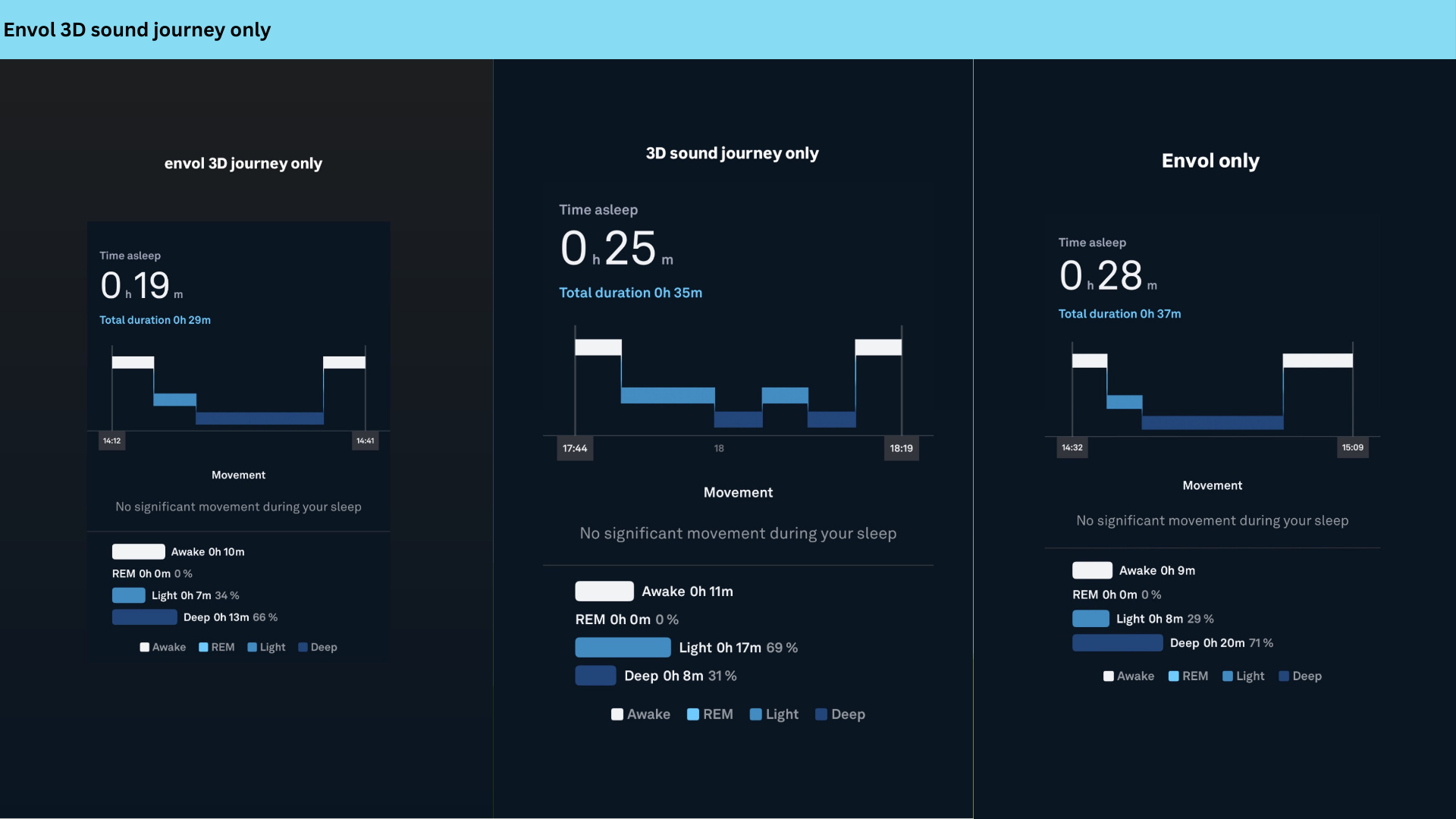
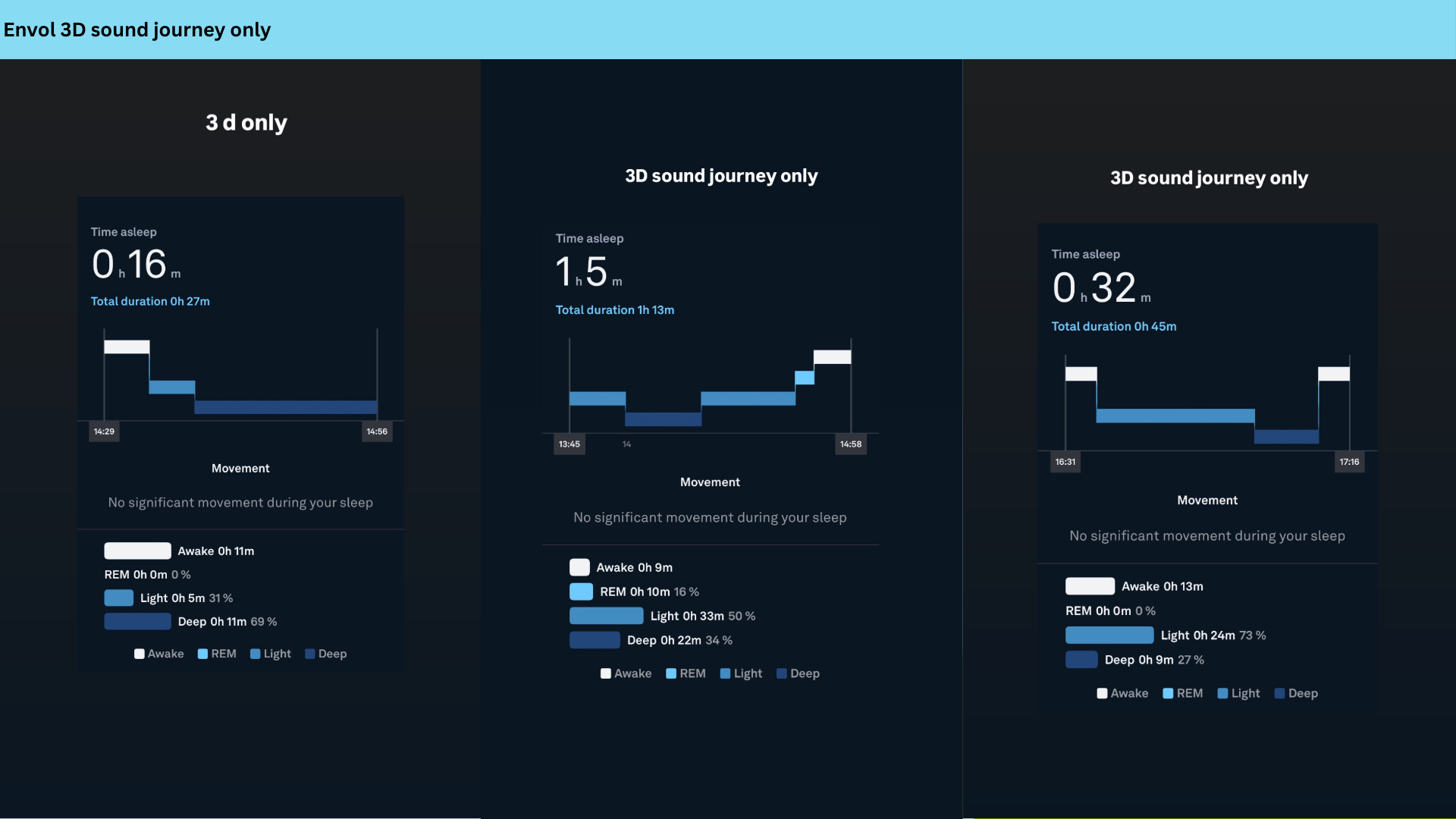
- Nap with Envol 3D sound journeys only (6 naps detected as sleep)
(immersive sound journeys designed to guide the nervous system into calm)
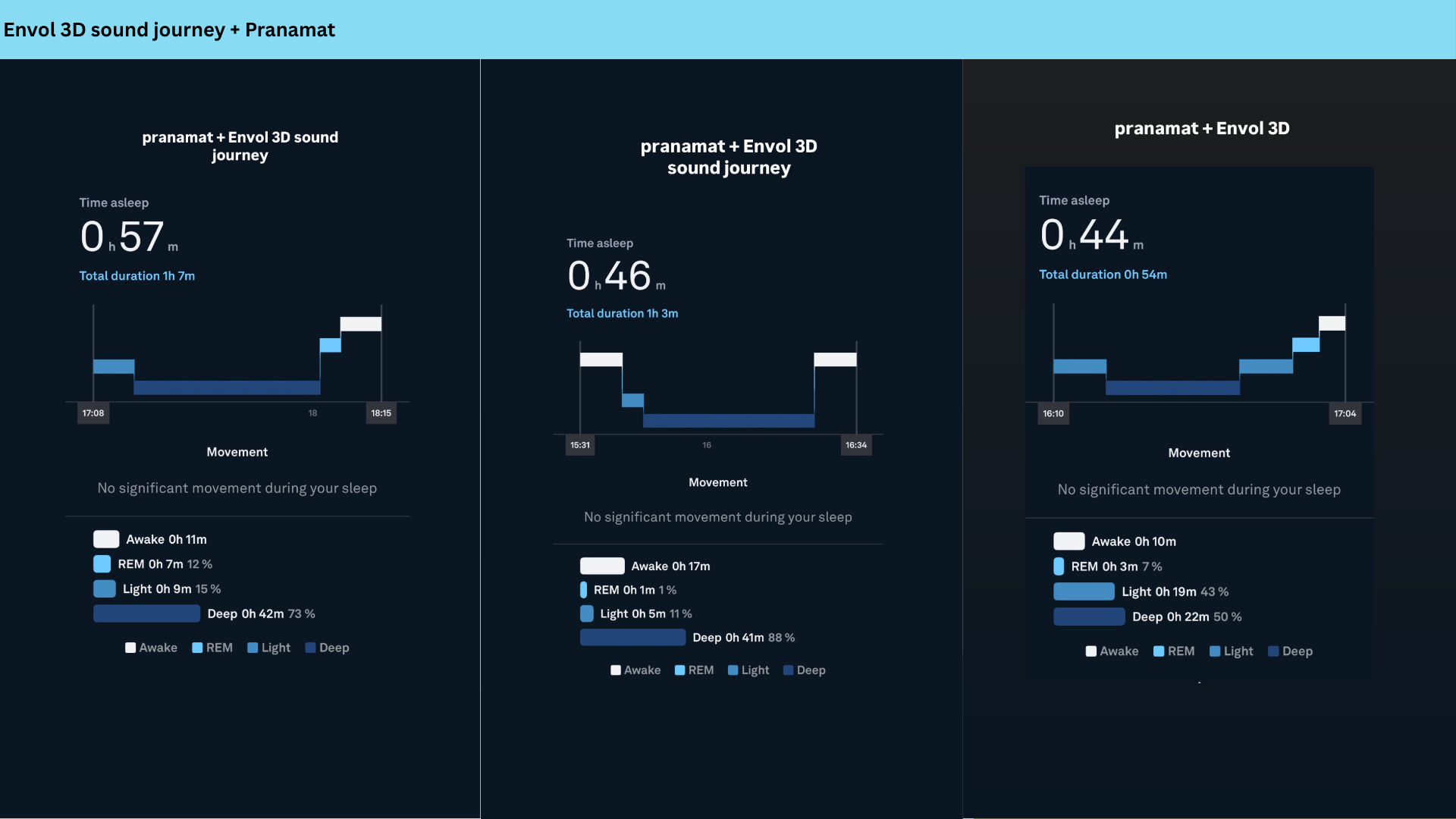
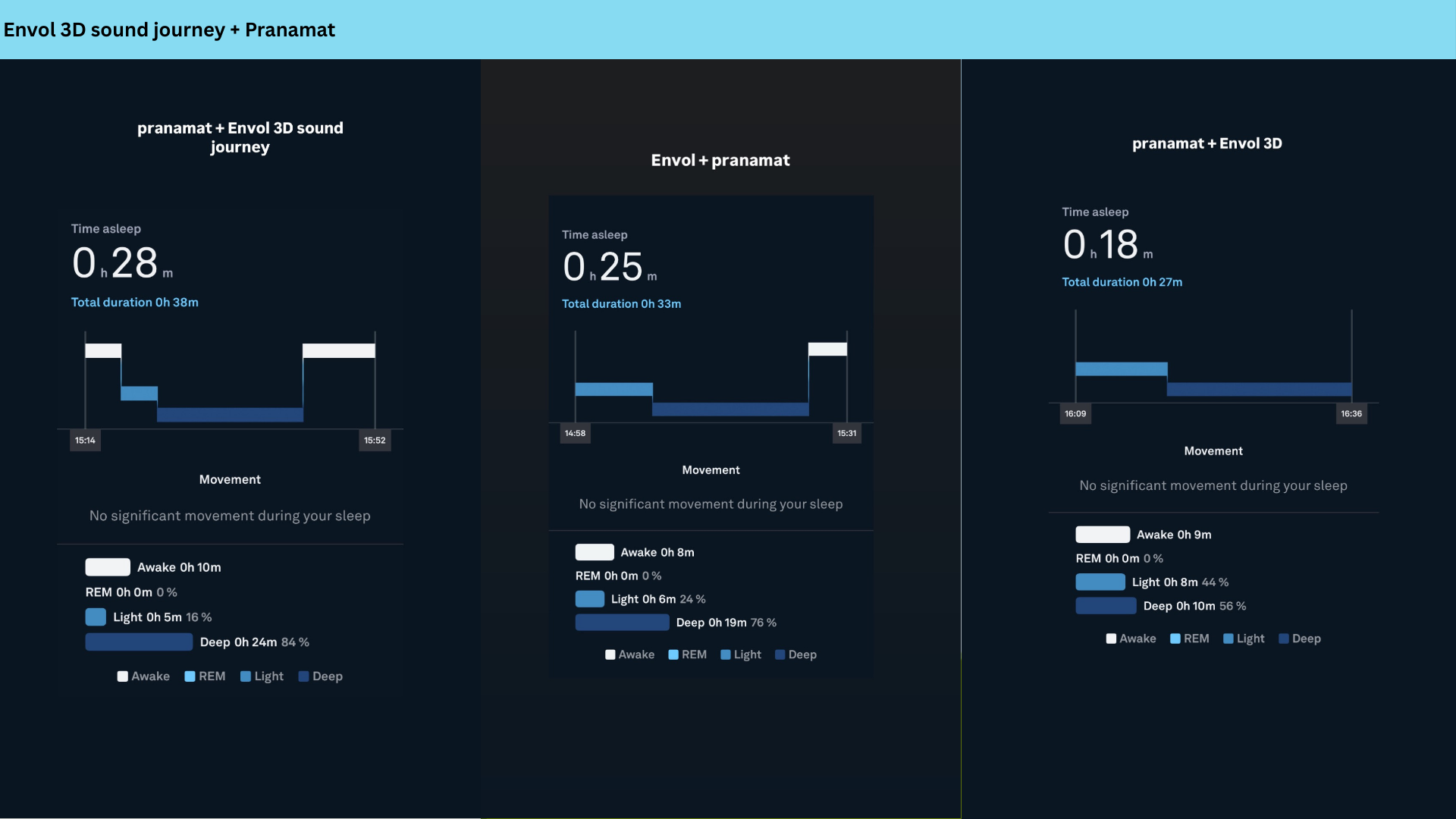
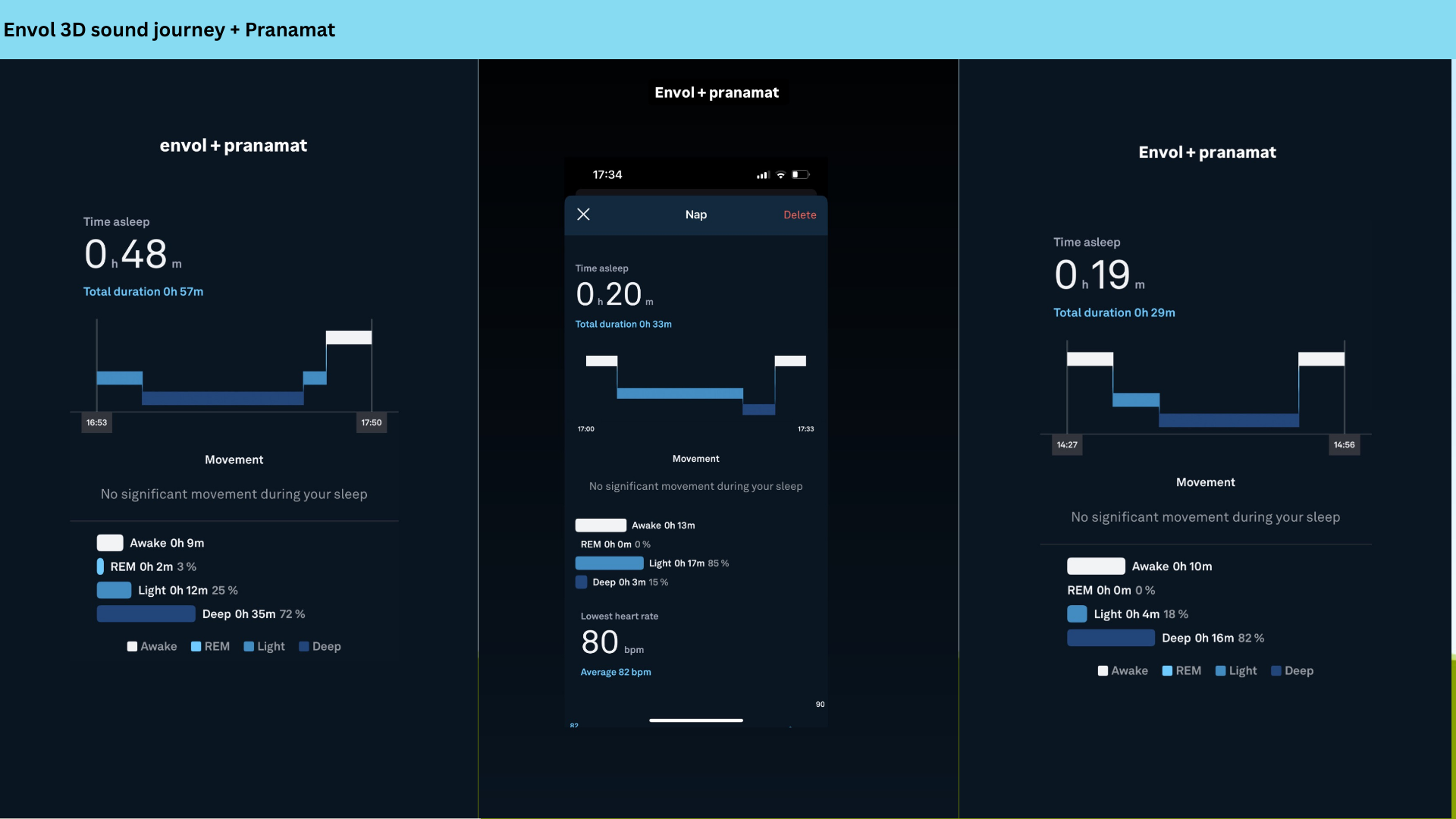
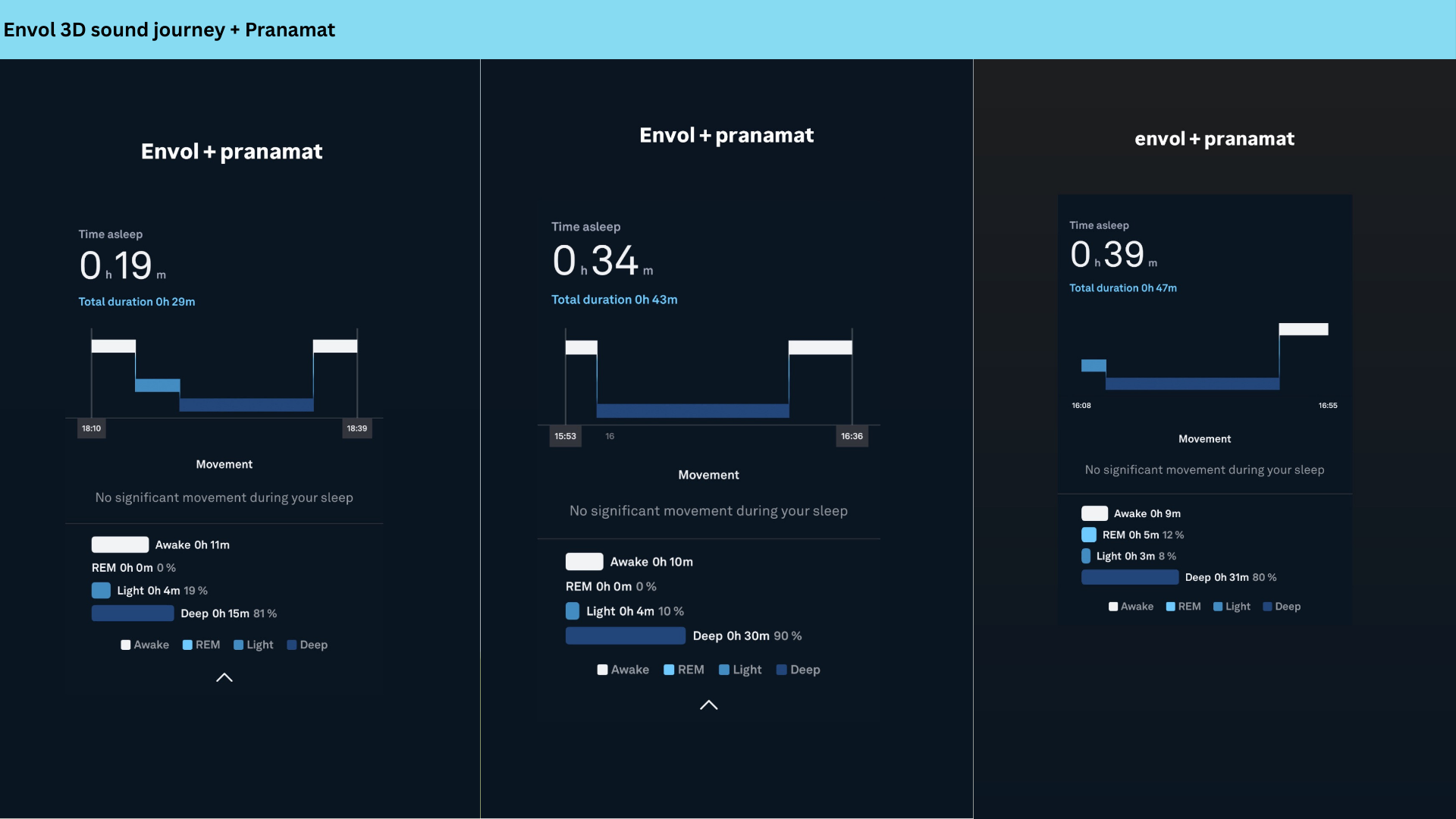
- Nap with Envol + Pranamat together (
12 naps detected as sleep)
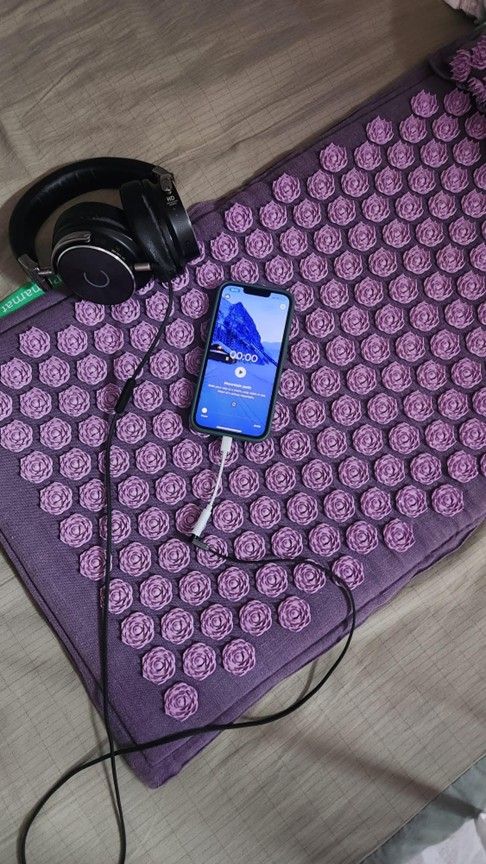
(lying on the Pranamat while listening to an Envol 3D sound journey)
In addition to these detected naps, several nap attempts were recorded only as “rest” by the Oura Ring and did not cross the physiological threshold required for sleep-stage analysis.
Because consistency matters just as much as depth, we tracked both sleep quality and how often each setup actually resulted in sleep.
These results are summarized later in the article, taking into account both sleep quality and how often each setup actually resulted in sleep.
Methodology
•
Only naps physiologically detected as sleep by the
Oura Ring were included.
• Sessions detected only as “rest” (relaxation without sleep physiology) were excluded from sleep metrics.
• In addition to the 26 included naps, more than 12 additional nap attempts did not cross the sleep threshold and were therefore excluded.
Those excluded attempts occurred primarily during:
• nap-only sessions, and
• Pranamat-only sessions, where relaxation was present but sleep onset was inconsistent.
This is why the final dataset includes 26 naps (not due to lack of attempts, but because the nervous system does not always fully transition into sleep, even when rest is intentionally created.
Metrics observed:
• total sleep time
• deep sleep minutes
• deep sleep percentage
• REM and light sleep
• % of nap attempts that became sleep
This was not a clinical trial, but a structured self-experiment combining objective biometric data with lived experience.
What the data showed
1. Nap only (no tools): moderate recovery, high variability
Across nap-only sessions (5 detected naps, 8 total attempts):
• Average deep sleep: ~43%
• Deep sleep ranged from 0% to ~83%, depending on the session
• Light sleep often made up a large portion of the nap
• REM sleep was present in some sessions but inconsistent
• 3 out of 8 nap-only attempts did not cross into sleep and were recorded only as “rest”
Interpretation:
Unassisted naps can provide some recovery, but results are highly dependent on the nervous system’s state that day. Some naps reached meaningful deep sleep, while others stayed mostly in lighter stages. Consistency was the main challenge.
2. Nap with Pranamat only: strong relaxation, but inconsistent sleep entry
When sleep was detected with Pranamat (3 detected naps, 7 total attempts):
• Average deep sleep: ~71%
• Deep sleep ranged from ~45% to ~89%
• Light sleep and REM were generally lower when sleep occurred
• 4 out of 7 Pranamat-only attempts did not cross into sleep and were classified only as “rest”
Interpretation:
Pranamat clearly induces physical relaxation. After a few minutes on the mat, the body releases endorphins, helping shift attention out of the mind and into the body.
But relaxation alone does not consistently push the nervous system into a restorative sleep state.
3. Nap with Envol 3D sound journeys only: improved consistency
Across Envol-only naps (6 detected naps, 7 total attempts):
• Average deep sleep: ~50%
• Deep sleep ranged from ~27% to ~71%
• Total nap duration was generally shorter
• Only 1 out of 7 attempts did not cross into sleep
Interpretation:
Guided sound appears to help the nervous system cross into sleep more reliably, even during shorter naps. While deep sleep percentages were slightly lower than Pranamat-only when sleep occurred, consistency was higher.
4. Nap with Envol + Pranamat together: deepest sleep in the shortest time
This combination produced the strongest and most consistent results.
Across Envol + Pranamat naps (12 detected naps, 12 total attempts):
• Average deep sleep: ~71%
• Deep sleep ranged from ~15% to ~90%
• Several naps exceeded 80% deep sleep
• All attempts crossed into sleep (100% reliability)
Interpretation:
This setup didn’t make naps longer - it made them denser in recovery. The combination appears to help the nervous system cross into sleep reliably and spend a greater proportion of that time in deep, restorative stages.
Key takeaway
The difference wasn’t how long the naps were. It was how efficiently the nervous system entered deep recovery.
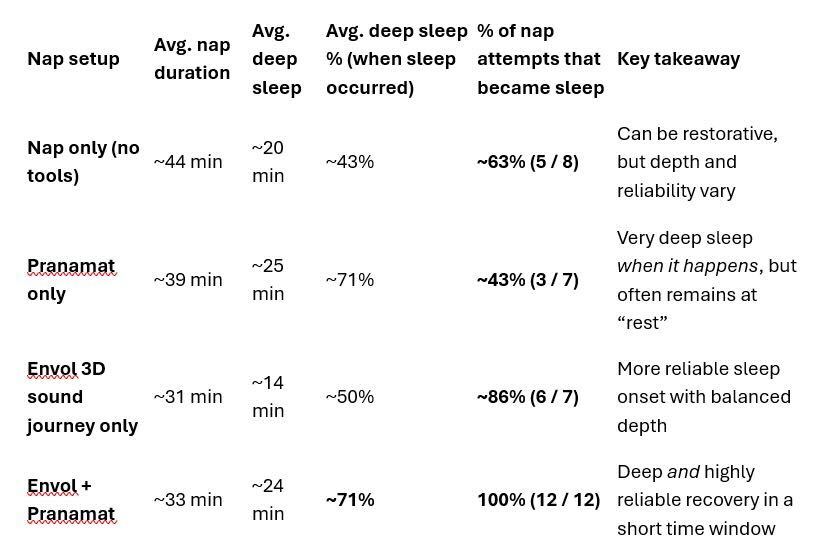
| NAP SETUP |
AVG. NAP DURATION |
AVG. DEEP SLEEP |
AVG. DEEP SLEEP %
(when sleep occured) |
% OF NAP ATTEMPTS THAT BECAME SLEEP |
KEY TAKEAWAY |
| NAP ONLY (no tools) |
~ 44 min |
~ 20 min |
~ 43% |
~ 63% (5/8) |
Can be restorative, but depth and reliability vary |
| PRANAMAT ONLY |
~ 39 min |
~ 25 min |
~ 71% |
~ 43% (3/7) |
Very deep sleep when it happens, but often remains at “rest” |
| ENVOL 3D SOUND JOURNEY ONLY |
~ 31 min |
~ 14 min |
~ 50% |
~ 86% (6/7) |
More reliable sleep onset with balanced depth |
| ENVOL + PRANAMAT |
~ 33 min |
~ 24 min |
~ 71% |
100% (12/12) |
Deep and highly reliable recovery in a short time window |
The difference wasn’t how long the naps were. It was how efficiently the nervous system entered deep recovery.
Deep sleep percentages are calculated only for naps that crossed into measurable sleep. The “% of attempts that became sleep” reflects how often each setup helped the nervous system cross that threshold.
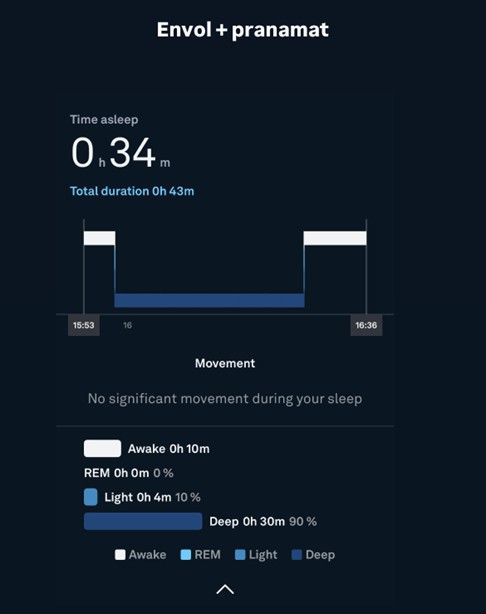
Example of a short afternoon nap where most of the sleep time was spent in deep sleep, as detected by the Oura Ring.
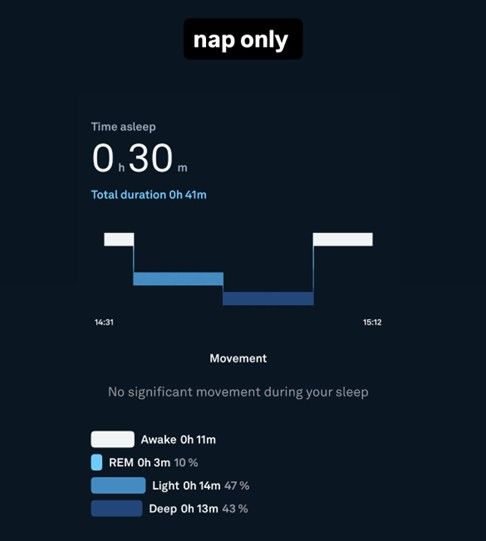
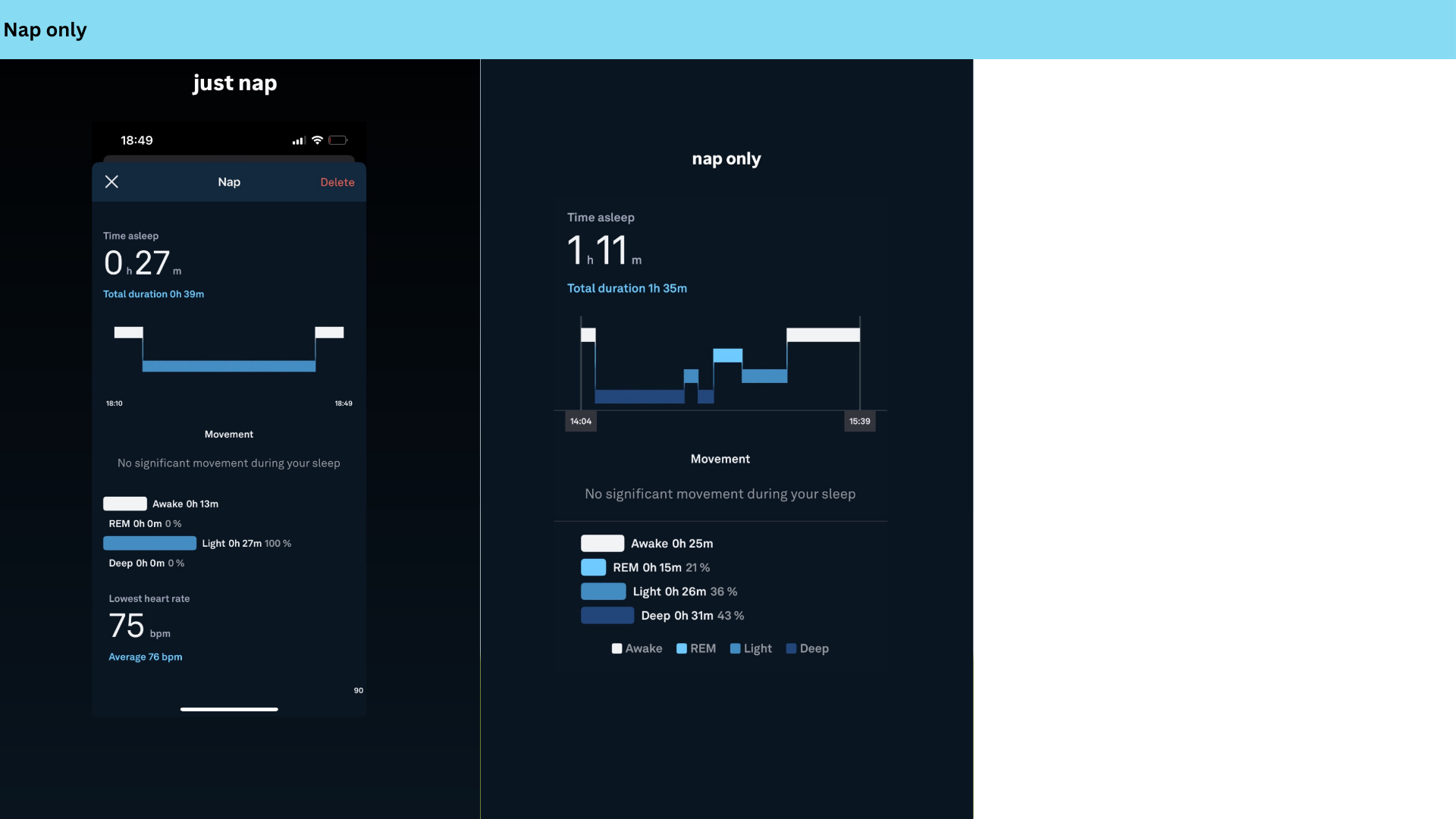
Example of a nap without tools. Although the nap felt restful, a large proportion of the sleep was light rather than deep, limiting overall recovery.
Why this works: regulation + guidance
Many tools help the body relax, but not that many help the nervous system transition.
To enter deep sleep, the brain needs safety signals, rhythmic predictability, a coherent sensory input, and a sense of permission to let go.
• slow, rhythmic pacing
• immersive 3D sound that gently alternates between ears, stimulating the vagus nerve
• nature-based soundscapes, which research links to reduced stress responses
• sound frequencies aligned with the Schumann resonance (7.83 Hz) (often associated in research with calm, grounded brain states, and faster healing).
Each journey also invites the mind to travel; to a rainforest, a hot spring, a remote landscape, helping disconnect from daily mental loops.
Somatic tools like Pranamat add another layer, with tactile grounding, body awareness, and endorphin release.
This is why Envol + Pranamat are so powerful together:
Together, they appear to help the nervous system cross the threshold into deep recovery more reliably.
A note on scientific integrity
This was not a large-scale study. The goal was not to prove efficacy, but to explore how different sensory inputs affect the nervous system’s ability to enter deep recovery when time is limited.
It was an internal, exploratory experiment using wearable data and lived experience.
We excluded sessions not detected as sleep to avoid inflating results. Interestingly, those excluded “rest-only” sessions became part of the insight.
Sometimes, what doesn’t show up in the data tells you just as much.
A deeper kind of recovery
Feeling wired but exhausted at the end of the day?
Experiencing brain fog that makes simple decisions feel harder than they should?
Feeling more irritable than usual?
Waking up at 3 a.m. for a bathroom trip, only to find your mind suddenly wide awake…looping, overthinking, unable to fall back asleep?
These experiences often share the same root: a nervous system that has been “on” for too long, without enough deep recovery during the day.
When the brain and nervous system get deeper rest earlier, they don’t need to “catch up” at night. The system becomes more resilient, less reactive, and better able to return to sleep when brief awakenings happen.
At Envol, our goal isn’t just to help people rest…it’s to help the nervous system access deeper recovery, more efficiently and more consistently, especially when time is limited.
Want to try it yourself?
We’re currently running a special partnership with
Pranamat:
• Shop Pranamat and receive 3 free months of Envol Premium
You can also try one of our 3D sound journeys for free inside the
Envol app:
we recommend starting with “Into the Rainforest”, ‘‘Tropical hotsprings’’ or ‘‘Mountain path’’.''

See all the data:
Download the Envol App today !